


Following a first day focused on democracy, civic resilience and cybersecurity, discussions on 13 October turned inward, examining not only how AI is changing society, but how it is changing museums and their operations from within. Across panel discussions, workshops and collective reflection, one message spoke clearly: technological change is ultimately about people, values and choices.
NEMO European Museum Conference 2026: Deep dive into trust, transformation and the futures museums choose


Who shapes reality in the age of AI?
After a welcome by NEMO Secretary General Julia Pagel, the day opened with a challenge to one of museums' core responsibilities: helping people make sense of the world around them. In the interactive demonstration Prompting reality?, Christine Koblitz (Wien Museum, Austria) invited audiences to generate images in real time through AI prompts. The exercise showed how easily assumptions, biases and stereotypes can enter AI-generated content, while also raising questions about authenticity and historical representation.


The demonstration continued into the panel discussion Trust, truth and AI – Museums as human mediators of reality?, moderated by Eva Koppen (ProMu, the Netherlands). Together with Christine Koblitz, Ugnė Paberžytė (MO Museum, Lithuania) and Lea Pavlov (Estonian Health Museum, Estonia), the discussion explored the growing tension between trust and truth in a world increasingly influenced by algorithms, synthetic media and AI-generated content.
Particular attention was given to the role museums can play as trusted mediators. While AI may generate convincing narratives and images, museums bring context, interpretation and critical reflection. Through her intervention Would you ask AI?, Lea Pavlov challenged participants to compare AI-generated and educator responses to questions related to sexual education, sparking reflection on empathy, credibility and the unique role of human-centred learning – with the plot twist that all reposes were AI-generated.

Rather than viewing AI as a threat to museum authority, the discussion suggested that the rise of synthetic media may make museums' educational role even more valuable. As audiences increasingly navigate uncertain information environments, museum professionals discussed how institutions can help people question, contextualise and critically engage with what they encounter.
The human side of AI
After the morning examination of AI's impact on public understanding, the next session turned to its impact on museums themselves. Two complementary panel discussions explored how artificial intelligence is transforming both everyday museum work and institutional leadership.
Moderated by Trilce Navarrete (Erasmus University, the Netherlands), the first panel, Changing from within: AI and the future of museum work, examined how workflows, roles and staff experiences are evolving.
Tuuli Ahlholm (Finnish Postal Museum, Finland) shared her museum's collaborative process for developing ethical AI guidelines. Rather than treating AI as a standalone technical issue, the Finnish Postal Museum involved staff across the organisation in discussions about responsible use, creating a process that continues to evolve alongside the technology itself. Johannes C. Bernhardt (University of Konstanz, Germany) reflected on how AI is reshaping relationships between people, technology and work. His contribution explored questions of ownership, authority and changing employee journeys in a context where AI can increasingly contribute to creative and professional tasks.
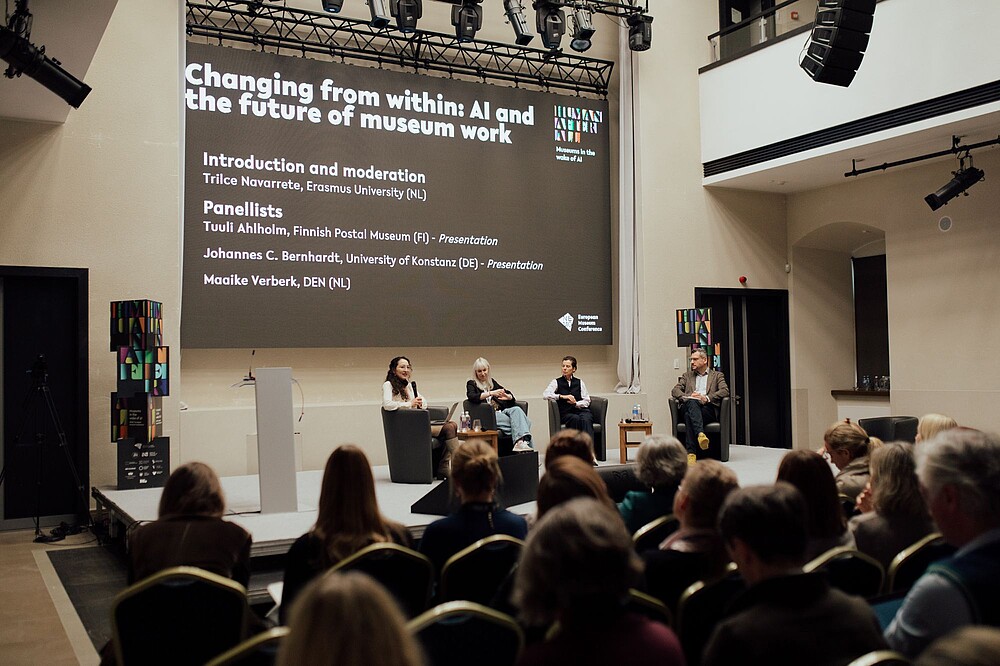
Together with Maaike Verberk (DEN, the Netherlands), the panel considered how museums can support staff through this period of change. The discussion focused less on technology itself and more on learning, adaptation and the skills needed to integrate AI meaningfully into everyday practice.
The second panel, Leading the shift: Museums, AI and institutional strategy, continued the conversation from a leadership perspective. Moderated by Merete Sanderhoff (National Gallery of Denmark, Denmark), the discussion brought together Oonagh Murphy (Goldsmiths, University of London/British Council, United Kingdom), Gaja Zornada (Computer History Museum, Slovenia) and Olga Tykhonova (MUSEUM BOOSTER, Austria/Ukraine).


Drawing on a presentation, delivered digitally, by Oonagh Murphy on AI leadership competencies, the panel explored how institutions can move beyond experimentation towards more strategic approaches to AI adoption. Discussions addressed governance, organisational readiness, collaboration and the importance of aligning AI initiatives with institutional values and mission. While the previous panel focused on staff and workflows, this discussion highlighted the responsibilities facing museum leaders as they navigate uncertain technological futures.
From discussion to practice
The afternoon programme once again translated conference themes into hands-on learning. Across a series of workshops and breakout session, participants explored how museums can experiment with AI while remaining grounded in institutional values, sustainability and long-term thinking.
Elizabete Palasiosa (Latvian Academy of Culture) and Toms Zarāns (Rizz Group AI, Latvia) invited participants to experiment with generative AI as a tool for storytelling and audience engagement. Starting from a single image, participants explored how technological tools can generate new narratives, experiences and points of access to collections.


Questions of sustainability took centre stage in the workshop led by Birgitte Kehler Holst (Green Museum Academy, Association of Danish Museums) and Madeleine Schlawitz (Royal Danish Library, Denmark). Their session examined the environmental impact of museums' growing digital presence and encouraged participants to consider sustainability alongside digital transformation.
Leslie P. Zimmermann (Reiss-Engelhorn-Museen Mannheim & University of Mannheim, Germany), Olivia Braun (Landesmuseum Württemberg, Germany) and Elfi Carle (Landesmuseum Württemberg, Germany) focused on the organisational realities of rapid technological change. Rather than discussing AI functionality, they encouraged participants to reflect on institutional resilience, uncertainty and care in a time of constant transformation.


Isabella Ducros (Italy) guided participants through the co-creation of institutional AI manifestos, supporting museums to move from abstract ethical principles towards concrete commitments and practical implementation frameworks.
Meanwhile, Sandro Debono (University of Malta) and Richard Sandford (UCL – University College London, United Kingdom) encouraged participants to think systematically about the future through foresight methodologies and futures thinking. Their workshop explored how museums can move beyond reacting to change and instead proactively shape their own futures. Olga Tykhonova (MUSEUM BOOSTER, Austria/Ukraine) introduced the concept of "digital courage". Participants explored ways of building confidence and collective capacity within organisations, emphasising collaboration and shared responsibility over technological anxiety.


From discussion to direction
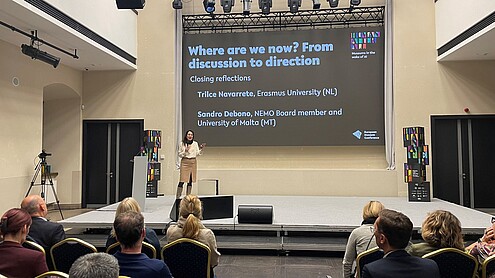
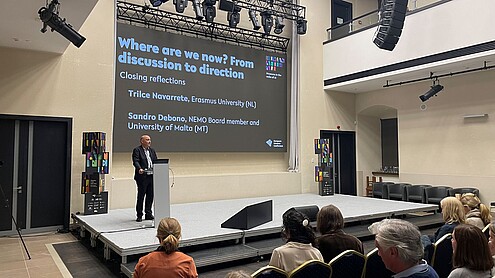
The conference concluded with a participatory wrap-up session titled Where are we now? From discussion to direction. Facilitated by NEMO’s Mareen Maaß and Anne-Sophie Gutsche, participants engaged in a "Museum AI Future Summit", voting on scenarios for 2030 and reflecting on themes that had shaped the conference over the previous two days. Questions ranged from future museum work and leadership to trust, cybersecurity, democratic resilience and public engagement. Participants considered not only what futures they expected, but what actions museums should take today to prepare for them.


Closing reflections were offered by Trilce Navarrete and Sandro Debono, who helped connect the many threads running through the conference programme. Their reflections reinforced a conclusion that had surfaced repeatedly throughout the conference: the future is not something museums merely adapt to. It is something they help create.
In her closing remarks, Petra Havu, Chair of NEMO's Executive Board and CEO of the Finnish Museums Association, announced that the 2027 NEMO European Museum Conference will take place in Madrid, Spain, from 3-5 October, co-organised with NEMO member the Ministry of Spain. Sign up for a reminder when registration opens.
Conference closing
The formal programme concluded at the National Gallery of Art in Vilnius, where participants gathered for the closing reception. Welcomed by Petra Havu, Rūta Kačkutė, Director General of the Lithuanian National Museum, and Marius Pečiulis, Chairman of the Board of the Lithuanian Museums Association, participants continued discussions that had begun in meeting rooms, workshops and panel sessions.


A performance by the Ąžuolų Club Men's Choir provided a fitting backdrop to the evening and a chance to celebrate the many conversations, connections and collaborations developed over the previous days.


Looking back
Across two days of discussions, demonstrations, workshops and exchanges, the NEMO European Museum Conference 2026 repeatedly returned to the relationship between technology and humanity.
Whether discussing democratic resilience, trust, museum work, leadership or digital futures, participants agreed on one thing: AI may be transforming the environments in which museums operate, but museums retain the ability, and perhaps the responsibility, to shape how these technologies are understood, used and governed. Or, as the conference theme reminded participants throughout the event: Human after all.


Conference partners and supporters
The conference was co-organised by NEMO - the Network of European Museum Organisations, the Lithuanian Museums Association, and the National Museum of Lithuania, with the financial support of the Ministry of Culture of the Republic of Lithuania, the Lithuanian Council for Culture, and the European Union.
It was supported by Go Vilnius, the Lithuanian National Museum of Art, the National Museum – Palace of the Grand Dukes of Lithuania, and Vilnius UNESCO City of Literature.
The cultural programmed was made possible thanks to MO Museum, Vilnius City Museum, and Vilnius University Museum.
NEMO is a network powered by the German Museums Association.
Also interesting
The Austrian Museums Association (Museumsbund Österreich) and QWB Lab, both NEMO members, has published a new study exploring the…
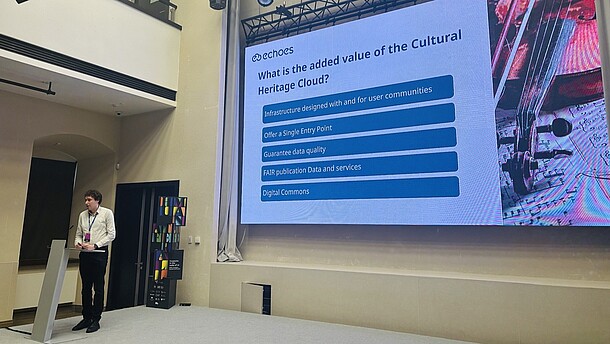
On 14 October 2026, following the NEMO European Museum Conference in Vilnius, museum and cultural heritage professionals gathered at the Palace of the Grand Dukes for a regional meeting organised by the ECHOES project. Bringing…
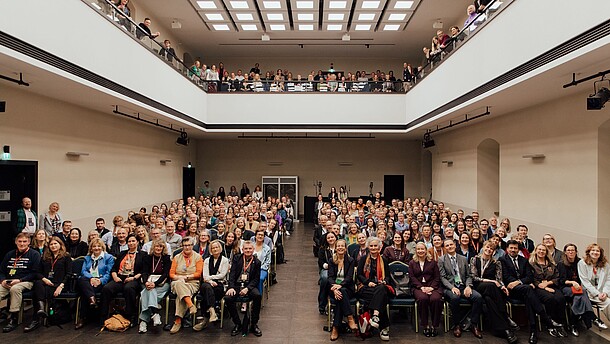
330 participants from 41 countries have gathered in Vilnius, Lithuania, for the NEMO European Museum Conference 2026: Human after all – Museums in the wake of AI. The first full day of the conference programme on 12 October…