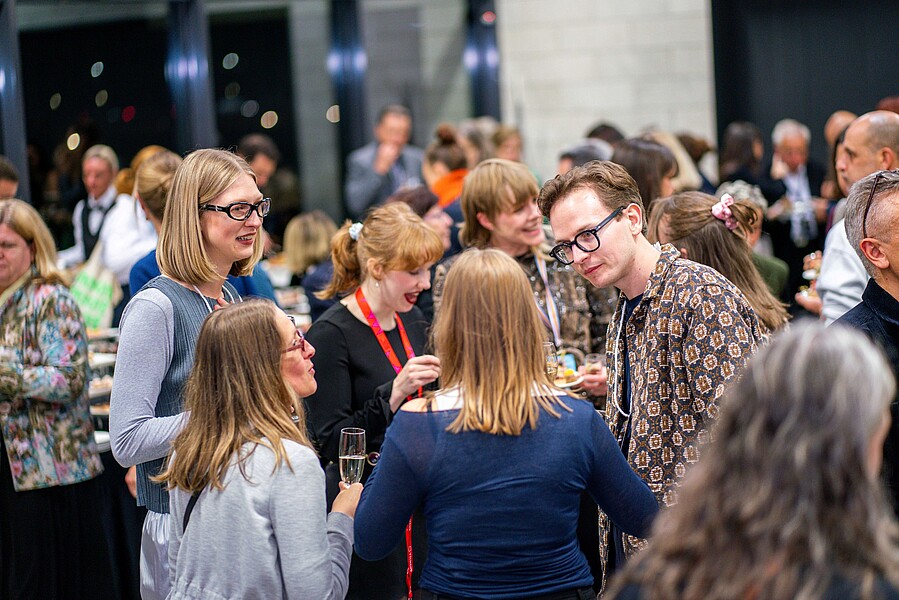
The NEMO European Museum Conference 2026: Human after all – Museums in the wake of AI took place from 11–13 October. In Vilnius, Lithuania, we gathered with 330 participants from 41 countries to rethink the human role in museums in an age shaped by AI and increasing digital vulnerability. Keep scrolling for the recordings, a NEMO statement, photos, and resources.
Through keynotes, panels, workshops and peer exchange, conference participants explored how AI is reshaping trust, democratic participation, museum work, leadership and public engagement. Discussions ranged from AI-generated realities and critical AI literacy to cybersecurity, organisational transformation and the future of museum practice.
A central theme throughout the conference was agency. Rather than viewing AI as an inevitable force, speakers and participants explored how museums can actively shape technological change through human-centred approaches, ethical decision-making and collaboration. Museums emerged not merely as users of technology, but as trusted institutions that can help people navigate complexity, strengthen critical thinking and contribute to resilient and democratic societies.
NEMO statement
Drawing on discussions at the conference, the NEMO Executive Board published a statement on the role of museums and their needs in an age increasingly shaped by artificial intelligence. AI is developing rapidly and provoking a wide range of reactions across the museum sector, from anxiety and concern to curiosity, excitement and a desire to explore its possibilities. To help guide the path forward, the statement:
- Encourages the sector to develop clear policies, guidelines and a shared understanding of the ethical use of AI.
- Urges policy makers to recognise museums as essential actors in European AI policy and as key partners in building AI literacy, fostering critical thinking and strengthening social trust.
- Highlighs the growing risks posed by cyberattacks, disinformation and the manipulation of digital heritage, and calls for greater awareness of museums' role in societal resilience. As society’s most trusted institutions, museums are great assets but at the same time targets.
Read the full statement below, also available as pdf.

Revisit the conference
To relive, or experience for the first time, the NEMO European Museum Conference 2026, check out the photos and recordings.
Find more details about the conference, programme and outcomes in our more detailed Day 1 and Day 2 summaries as well as the recap of the ECHOES side event.
If you're looking for additional resources, check out the Community Resource Hub for books, articles, podcasts, courses and much more on AI and digital.






Recordings
Due to technical issues with the sound, we are still editing the recording of the live hacking demonstration and panel Under attack: Cybersecurity, trust and Resilience in Museums, which took place on 12 October. We hope to publish the recording soon.
Although some recordings may contain minor sound issues, we hope they provide valuable insights and inspiration.
In the opening keynote speech, AI ethicist and political philosopher Annette Zimmermann challenged technological determinism by arguing that AI is not an unstoppable force but a political and societal choice. Rather than seeing themselves as passive users of technology, museums were encouraged to think of their role as active contributors to democratic participation, critical thinking and public agency. The keynote returned to questions of power and responsibility. Who shapes technological development? Who benefits from it? And what role can trusted public institutions like museums play in ensuring that citizens remain active participants in the future being created around them?
In the strategic conversation, Museums as civic actors in the wake of AI, Magnus Hjort, Director General of the Swedish Psychological Defence Agency, and Vera Carasso, Director of the Royal Dutch Museums Association and Vice-Chair of NEMO's Executive Board, explored the role of museums as civic actors in the age of AI. Discussing trust, democratic resilience and the challenges of misinformation, they highlight how museums contribute to stronger, more connected societies through dialogue, critical engagement and community building.
Short Cuts, moderated by Heledd Ruddigkeit (NEMO), brought together a series of rapid-fire presentations showcasing how museums across Europe are already experimenting with AI in practice. Arūnas Gelūnas (Lithuanian National Museum of Art) shared how AI can be used to encourage slower and deeper engagement with artworks rather than accelerate consumption. Corinna Engel (Museum for Communication Frankfurt, Germany) shared examples of how museums can foster critical AI literacy and public understanding of algorithmic bias and human-machine communication. Giedrė Milerytė-Japertienė (National Museum of Lithuania) presented Lithuania's national digital cultural heritage platform and its use of AI to improve access to collections and cultural data. Sofiya Petrova (Erasmus University Rotterdam, The Netherlands) explored how curators in Dutch art museums are experimenting with AI in exhibition-making and reflected on both its opportunities and limitations. Finally, Janet Dugdale (Museums Association, United Kingdom) highlighted the growing importance of ethics in museum AI adoption and shared perspectives from ongoing work on AI and museum ethics.
This session opened with Prompting reality?, an interactive demonstration by Christine Koblitz (Wien Museum, Austria) exploring how AI-generated images can reproduce biases, stereotypes and assumptions. This set the stage for the panel discussion Trust, truth and AI – Museums as human mediators of reality?, moderated by Eva Koppen (ProMu), with Christine Koblitz, Ugnė Paberžytė (MO Museum) and Lea Pavlov (Estonian Health Museum). Together, they examined how museums can help audiences critically navigate AI-generated content, synthetic media and increasingly complex information environments, highlighting the continued importance of human interpretation, context and trust.
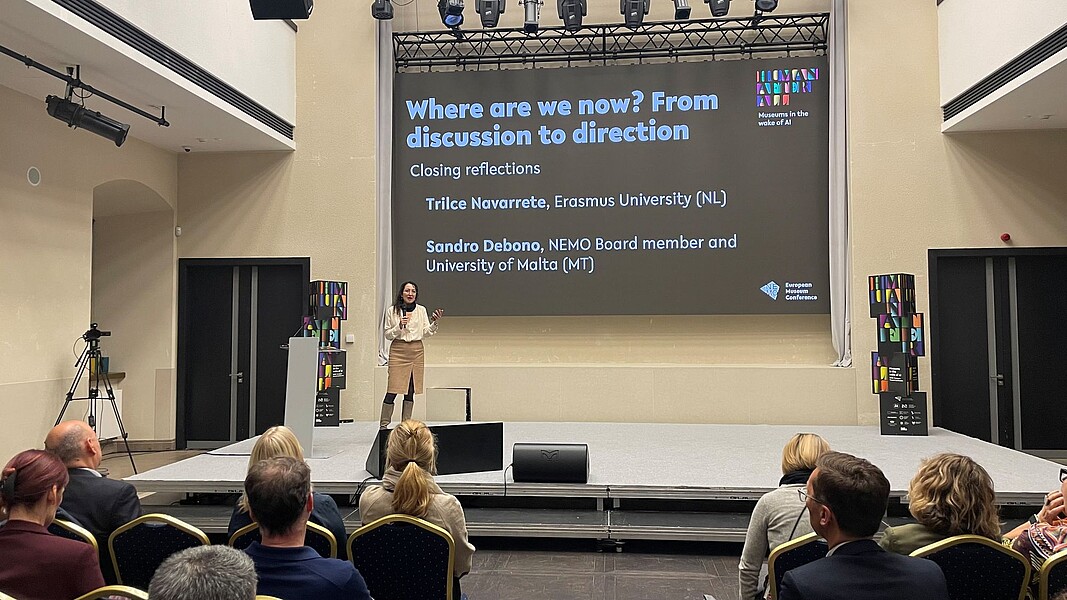
Two complementary panel discussions explored how artificial intelligence is transforming both everyday museum work and institutional leadership. The first one Changing from within: AI and the future of museum work, moderated by Trilce Navarrete (Erasmus University, the Netherlands), examined how AI is reshaping workflows, staff roles and organisational culture, with contributions from Tuuli Ahlholm (Finnish Postal Museum, Finland), Johannes C. Bernhardt (University of Konstanz, Germany) and Maaike Verberk (DEN, the Netherlands).
In the second panel, Leading the shift: Museums, AI and institutional strategy, moderator Merete Sanderhoff (National Gallery of Denmark) and panellists Oonagh Murphy (Goldsmiths, University of London/British Council), Gaja Zornada (Computer History Museum) and Olga Tykhonova (MUSEUM BOOSTER) explore how museums can move beyond AI experimentation towards strategic adoption. The discussion examines leadership, governance, organisational readiness and the importance of aligning AI initiatives with institutional values and mission in a rapidly changing technological landscape.
Supported by
Co-organisers
Financed by

Partners


Partners of the cultural programme


NEMO is a network powered by