


The conversation already began yesterday when participants met to explored Vilnius and its cultural heritage through a range of museum visits and guided tours across the city. Later, NEMO members gathered for the annual Members' Connect before all conference participants came together at the opening reception at the Museum of Applied Art and Design.
330 participants join NEMO European Museum Conference 2026 to explore the role of museums in an AI-shaped world


© Image: E. Skomskytė
Accompanied by a performance by the Vilnius Folklore Ensemble Virvytė and welcome remarks by Vera Carasso (Royal Dutch Museums Association and Vice-Chair of the NEMO Executive Board) and Arūnas Gelūnas (Director General of the Lithuanian National Museum of Art), the evening offered a first opportunity to reconnect with colleagues, make new contacts and begin exploring the conference theme together.
The conference programme kicked off on Monday morning with welcoming remarks by Petra Havu, Chair of NEMO's Executive Board and CEO of the Finnish Museums Association, alongside Lithuania's Minister of Culture Lukas Alsys, Ramunė Šmigelskytė-Stukienė from the National Museum – Palace of the Grand Dukes of Lithuania, Nela Riehl, and Member of Parliament and Chair of the CULT Committee on Culture and Education who shared a digital welcome.
The opening keynote by AI ethicist and political philosopher Annette Zimmermann set the tone for the days ahead. Challenging technological determinism, Zimmermann argued that AI is not an unstoppable force but a political and societal choice. Rather than seeing themselves as passive users of technology, museums were encouraged to think of their role as active contributors to democratic participation, critical thinking and public agency.
The keynote returned to questions of power and responsibility. Who shapes technological development? Who benefits from it? And what role can trusted public institutions like museums play in ensuring that citizens remain active participants in the future being created around them?

From cultural institutions to civic actors
These questions carried directly into the morning's strategic conversation, Museums as civic actors in the wake of AI, between Magnus Hjort, Director General of the Swedish Psychological Defence Agency, and Vera Carasso, Director of the Royal Dutch Museums Association and Vice-Chair of NEMO's Executive Board. By meeting in a conversation on the stage, they brought together two perspectives that do not often meet: psychological defence and museums. The discussion aimed to challenge museums to think beyond their traditional cultural role and consider their contribution as civic actors.


In a time of information manipulation, misinformation and growing uncertainty, trust is emerging as a key resource for democratic resilience. This resilience is not built during a crisis, but rather beforehand through participation, inclusion, strong communities and collaboration across sectors. Museums have a unique contribution to make through their ability to convene dialogue, foster critical engagement and support social cohesion. Additionally, Hjort finds that museums, as societies’ most trusted institutions, are part of society's resilience infrastructure and that this is an important role to keep and cultivate.
The conversation was opened with an interactive exercise facilitated by NEMO’s Mareen Maaß and Rebecca Thonander to activate the participants to reflect on whether museums should increasingly be understood as part of society's democratic infrastructure.


From reflection to practice
Across a series of breakout sessions and workshops, participants explored how museums can respond to rapid technological change in concrete ways. Some looked towards the future, such as the workshop of Maaike Verberk (DEN, The Netherlands) on future audiences and scenario planning. Others focused on values, strategy and governance, with Merete Sanderhoff (SMK, the National Gallery of Denmark) examining how museums can align AI adoption with institutional values.


Questions of resilience and sustainability were also present. Rémi Martin De Abia (Advens & ethical hacker, France) introduced participants to the mechanics of cyberattacks through a live hacking workshop, while Vera Carasso (Royal Dutch Museums Association, The Netherlands) and Erika T'Jaeckx (museumPASSmusées, Belgium) explored how museum card schemes can strengthen audiences and sector resilience. Agnė Sakevičiūtė (MO Museum, Lithuania) invited participants to consider how emotions influence trust and decision-making, demonstrating how museums can use art to encourage critical thinking in an age of misinformation and algorithmic influence.


Running alongside the breakout sessions, the Short Cuts session, moderated by Heledd Ruddigkeit (NEMO), offered quick 5-minute snapshots of actual AI examples in museum practice. Arūnas Gelūnas (Lithuanian National Museum of Art) shared how AI can be used to encourage slower and deeper engagement with artworks rather than accelerate consumption. Corinna Engel (Museum for Communication Frankfurt, Germany) shared examples of how museums can foster critical AI literacy and public understanding of algorithmic bias and human-machine communication. Giedrė Milerytė-Japertienė (National Museum of Lithuania) presented Lithuania's national digital cultural heritage platform and its use of AI to improve access to collections and cultural data. Sofiya Petrova (Erasmus University Rotterdam, The Netherlands) explored how curators in Dutch art museums are experimenting with AI in exhibition-making and reflected on both its opportunities and limitations. Finally, Janet Dugdale (Museums Association, United Kingdom) highlighted the growing importance of ethics in museum AI adoption and shared perspectives from ongoing work on AI and museum ethics. Together, the presentations demonstrated that museums across Europe are already testing, adapting and learning from AI in a variety of ways.

Under attack
The day concluded by confronting cybersecurity and its implications on museums, especially when AI enables the attackers to work faster and to produce more convincing campaigns. Putting the principle of learning by doing into practice (or rather, learning by seeing), the session began with a live hacking demonstration by Giulio Zucchini (Cyber for GOOD, France) and ethical hacker Rémi Martin De Abia (Advens, France). Step by step, participants watched how an email account could be compromised and how seemingly small vulnerabilities can be exploited by attackers.

The technical demonstration led into broader questions of governance, responsibility and resilience. During the panel, Cybersecurity & resilience – Defending cultural institutions in the digital age, discussion that followed the demonstration, Paulina Florjanowicz (ICOM Poland and NEMO board member) moderated a conversation with Johannes Vogel (Natural History Museum Berlin, Germany), Hannu-Pekka Polttila (Finnish Heritage Agency), Dagnija Baltiņa (National Library of Latvia), Giulio Zucchini and Rémi Martin De Abia.
Johannes Vogel joined digitally to share experiences from when the Natural History Museum Berlin was the victim of a cyber-attack in 2023. Hannu-Pekka Polttila gave a presentation exploring how cyberattacks can affect collections, research, operations, and public trust. The discussions between the panellists highlighted that cybersecurity can no longer be regarded solely as an IT concern. It is increasingly a leadership issue that requires preparedness, investment and cooperation across institutions and borders.

A common thread throughout the day
Although the day's sessions ranged from democratic resilience and AI ethics to future audiences and cybersecurity, a common thread connected them all. Speakers kept returning to the idea that the future is neither predetermined nor purely technological. Whether discussing trust, civic engagement, organisational change or digital security, the focus remained firmly on people and their institutions. Museums are not merely users of technology, but organisations that help citizens navigate new technology and complexity, build trust and shape the future together.
Conference partners and supporters
The conference was co-organised by NEMO - the Network of European Museum Organisations, the Lithuanian Museums Association, and the National Museum of Lithuania, with the financial support of the Ministry of Culture of the Republic of Lithuania, the Lithuanian Council for Culture, and the European Union.
It was supported by Go Vilnius, the Lithuanian National Museum of Art, the National Museum – Palace of the Grand Dukes of Lithuania, and Vilnius UNESCO City of Literature.
The cultural programmed was made possible thanks to MO Museum, Vilnius City Museum, and Vilnius University Museum.
NEMO is a network powered by the German Museums Association.
Also interesting
The Austrian Museums Association (Museumsbund Österreich) and QWB Lab, both NEMO members, has published a new study exploring the…
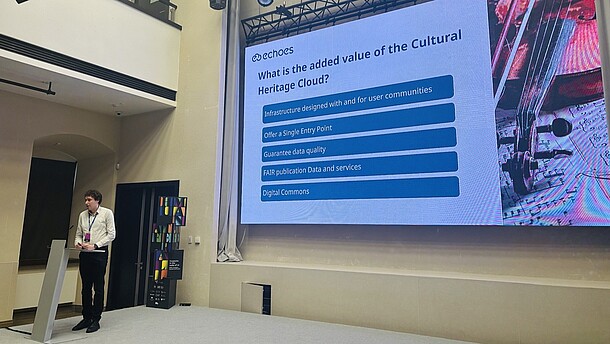
On 14 October 2026, following the NEMO European Museum Conference in Vilnius, museum and cultural heritage professionals gathered at the Palace of the Grand Dukes for a regional meeting organised by the ECHOES project. Bringing…
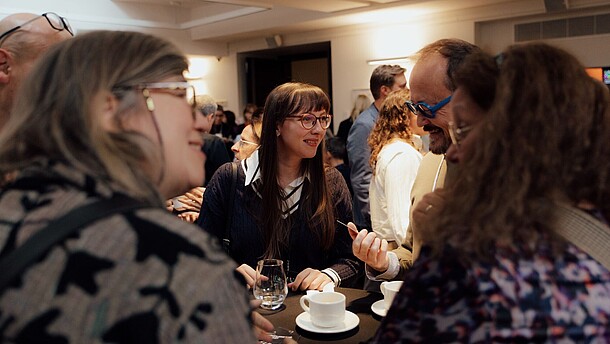
The second day of full conference programme at the NEMO European Museum Conference 2026 in Vilnius invited participants to look beyond AI as a technological development and consider its wider implications for truth, trust, work,…