


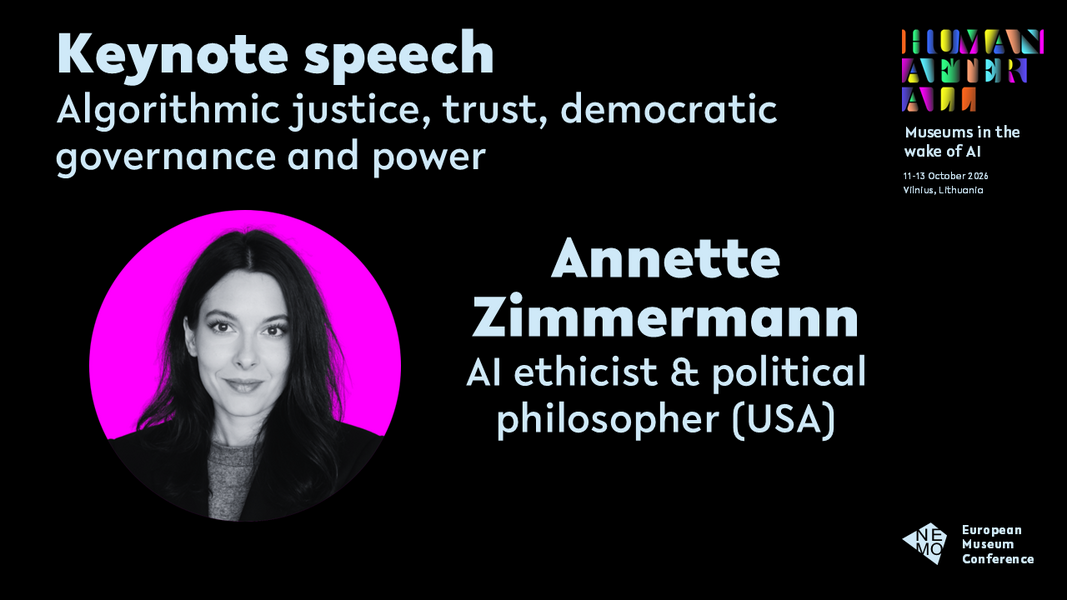
Taking place in Vilnius, Lithuania, from 11-13 October 2026, the NEMO European Museum Conference: Human after all – Museums in the wake of AI, explores the role of museums in a society increasingly shaped by artificial intelligence and what museums need to respond to and shape these developments. As trusted public institutions, museums can support their communities in navigating questions of participation, accountability, knowledge and democratic resilience in an increasingly data-driven world.
To help frame these discussions, NEMO is delighted to welcome Annette Zimmermann, Assistant Professor of Philosophy at the University of Wisconsin-Madison and one of the leading voices examining the ethical and political implications of AI. A political philosopher whose work centres on AI, democracy and questions of power, Zimmermann explores how societies can maintain democratic control over emerging technologies and ensure that technological development serves the public good.
Her recent book, Democratizing AI (2026), challenges two common narratives surrounding artificial intelligence: the belief that AI will automatically improve society, and the opposing assumption that its development is inevitable and beyond democratic oversight. Instead, Zimmermann argues that AI is fundamentally a question of power, participation and accountability. Technological futures are not predetermined, but shaped by human choices, institutions and democratic processes.
- To hear Annette Zimmermann live, make sure to get your ticket before registration closes on 20 September.
In conversation with Annette Zimmermann
Ahead of her visit to Vilnius, Zimmermann spoke with conference host the Lithuanian Museums Association about the challenges AI presents for democratic societies and the role cultural institutions can play in addressing them. The conversation touches on many of the themes that will be explored during the conference, from democratic oversight and public trust to the responsibility of museums in an age of increasingly powerful technologies. We are pleased to share the interview with the NEMO community.
Lithuanian Museums Association (LMA): In discussions about artificial intelligence, we often ask whether a system is accurate, safe and unbiased. But there is an earlier question: who has the right to decide what we delegate to algorithms in the first place? Are we too quick today to accept the adoption of new technologies as inevitable progress?
Annette Zimmermann: “Citizens and institutions serving the public good, like museums, would benefit from being much more skeptical of the tech-determinist myth that a particular trajectory of technological deployment is inevitable. Those trajectories are often unilaterally determined by a handful of Big Tech companies, and it’s not obvious that their interests and goals align with civic interests and goals. In my new book Democratizing AI, democratic oversight belongs to all affected members of society, not just AI developers, tech CEOs, and government bureaucrats at the top. Before optimizing systems, citizens must have a stronger voice in collective decisions about whether a given tool should be built at all. In order to do that, we need more frank and active public conversations about whether progress always necessarily means ‘the fastest and most resource-intensive technology’, or whether more holistic visions of progress are available.”
LMA: It is often said that AI becomes more “democratic” when more people have access to it. You link democratisation not only to access, but also to legitimacy. What real rights should people have to understand, challenge or reject AI-driven decisions that affect their lives?
Zimmermann: “Access to technology alone is insufficient for democratic legitimacy—even if that access is free. What we learned in the social media age, “if the product is free, you are the product”, is just as true now in the AI age as it was then. Big Tech benefits from everyone using their tools without having meaningful collective control over technology’s direction and purpose. Europe has already taken some meaningful steps to counter this problem, for instance by codifying particular civic rights, including the right to contest algorithmic decisions and to demand meaningful explanations for algorithmic outcomes. But more remains to be done, and not everything can be codified formally as a legal right. What we really need, on top of legal transformation, is a mindsetshift amongst citizens, civil society organizations, and the public sector: even if AI seems complicated and not everyone can be a technical expert, it’s up to all of us to articulate and negotiate the underlying ethical values that should drive technological progress. You don’t need a Computer Science PhD to participate in public deliberations about whether AI-powered mass surveillance is compatible with a truly free society, for example, or whether AI companies should be allowed to destroy millions of books, including rare books, for their own profit.”
LMA: Museums, universities and the media build their authority partly on their ability to explain where information comes from and why it should be trusted. Generative AI can produce convincing answers without making their origins clear. In the age of AI, will we need to redefine what a “trusted institution” means?
Zimmermann: “Generative tools may seem like they are sophisticated truth-tellers, producing fluent, authoritative text while completely hiding their sources. That can be dangerously misleading. Museums, universities, and journalism build trust precisely by showing their receipts and proving origin. If generative systems strip away provenance, institutions will have to prove their legitimacy by demonstrating accountability. Never has it been this important for museums and other pillars of democratic society to reveal data pipelines, and to actively challenge simplistic answers to complex historical matters.”
LMA: Algorithms learn from a world that already contains inequalities, stereotypes and historical omissions. This is particularly sensitive for museums, whose collections are not neutral either. Is there a risk that AI, when trained on historically biased data, will not only reproduce old stereotypes but present them as seemingly neutral or objective results?
Zimmermann: “There is not just a risk of feedback loops of this kind—they happen inevitably, and the interdisciplinary AI Ethics research community has provided copious amounts of empirical and theoretical evidence of this problem. The good news is: we can counteract such feedback loops by thinking critically about biases in training data and other sources, and by making choices about how to interrogate, contextualize, and counteract those biases today. Museums and universities, as stewards of collective memory and knowledge, have an absolutely essential role to play when it comes to leading a constructively critical public conversation on how technologies of the future should interact with artefacts of the past.”
LMA: This year’s NEMO conference is titled Human after all. What would it mean in practical terms to keep humans at the centre? Are there functions or responsibilities that, in your view, should never be delegated to an algorithm?
Zimmermann: “Centering humans means resisting the urge to substitute automated optimization for structural political solutions. High-stakes domains involving rights, freedom, and fundamental political choices—such as criminal justice sentencing or predictive policing—must never be fully delegated to automated systems. And some automated tools should simply not be built or deployed at all: those which inherently reinforce harmful assumptions, and those which have incredibly high-risk potential for misuse, including by third parties.”