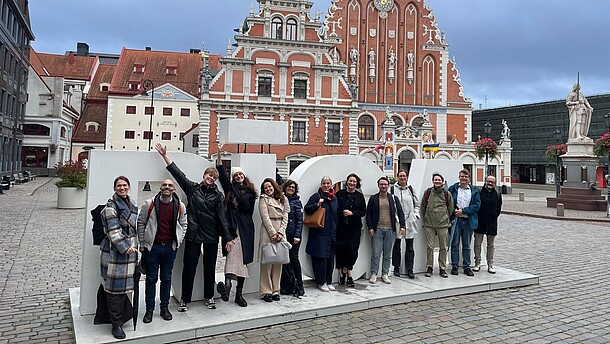



The workshop, delivered by Rebecca Thonander (NEMO Communications Officer) and Mareen Maaß (NEMO Programme Manager) on 12 May, was based on NEMO’s guideline “LGBTQIA+ Inclusion in European Museums. An incomplete guideline.” It offered participants a practical space to reflect on challenges and build confidence in addressing inclusion in their own institutions.
Over the course of the two‑hour session, participants explored how museums can create more inclusive environments for LGBTQIA+ communities - both as visitors and as staff. A central element of the workshop was working through real‑life dilemmas, such as responding to political resistance, implementing inclusive infrastructure, or raising awareness within teams. Rather than focusing on fixed solutions, the workshop emphasised a structured decision‑making process, enabling participants to consider stakeholders, possible actions and potential risks.
The approach reflects the core idea of NEMO’s guideline: that there are no universal answers, but that museums can benefit from shared frameworks and peer exchange when navigating complex situations. Participants were encouraged to engage critically, share experiences and develop their own responses, supported by practical tools that can be applied in their day‑to‑day work.
Supporting museums in navigating complex contexts
NEMO’s work on LGBTQIA+ inclusion stems from its broader commitment to supporting museums as open, inclusive and socially relevant institutions. In recent years, increasing political pressure and public debate around so‑called “sensitive” topics have made it more challenging for museums to engage with issues of identity and representation. The guideline and related workshops aim to support professionals in addressing these challenges confidently and responsibly. Another support action by NEMO in this regard is our resource hub for Independent museums and the NEMO Barometer on political influence in European museums. The recordings and reflections from the NEMO European Museum Conference 2024: Can we talk? Museums facing polarisation can also be helpful.
By combining reflection, practical tools and peer exchange, the workshop provided participants with a framework to approach inclusion not as a one‑off action, but as an ongoing organisational process. The session aimed to empower museum professionals to continue advancing inclusive practices in their institutions, even in complex or contested environments.